


Sonirity
3L Ultrasonic cleaner | SonicTitan
3L Ultrasonic cleaner | SonicTitan
☑️ Cleans What Cloths Can't Reach
☑️ Ultrasonic Cavitation Technology
☑️ Auto Shut-Off, No Over-Cleaning
☑️ Results in Minutes, No Scrubbing
Couldn't load pickup availability
Before You Start a Cycle, How to Set Temperature and Mode for What Is in the Tank?
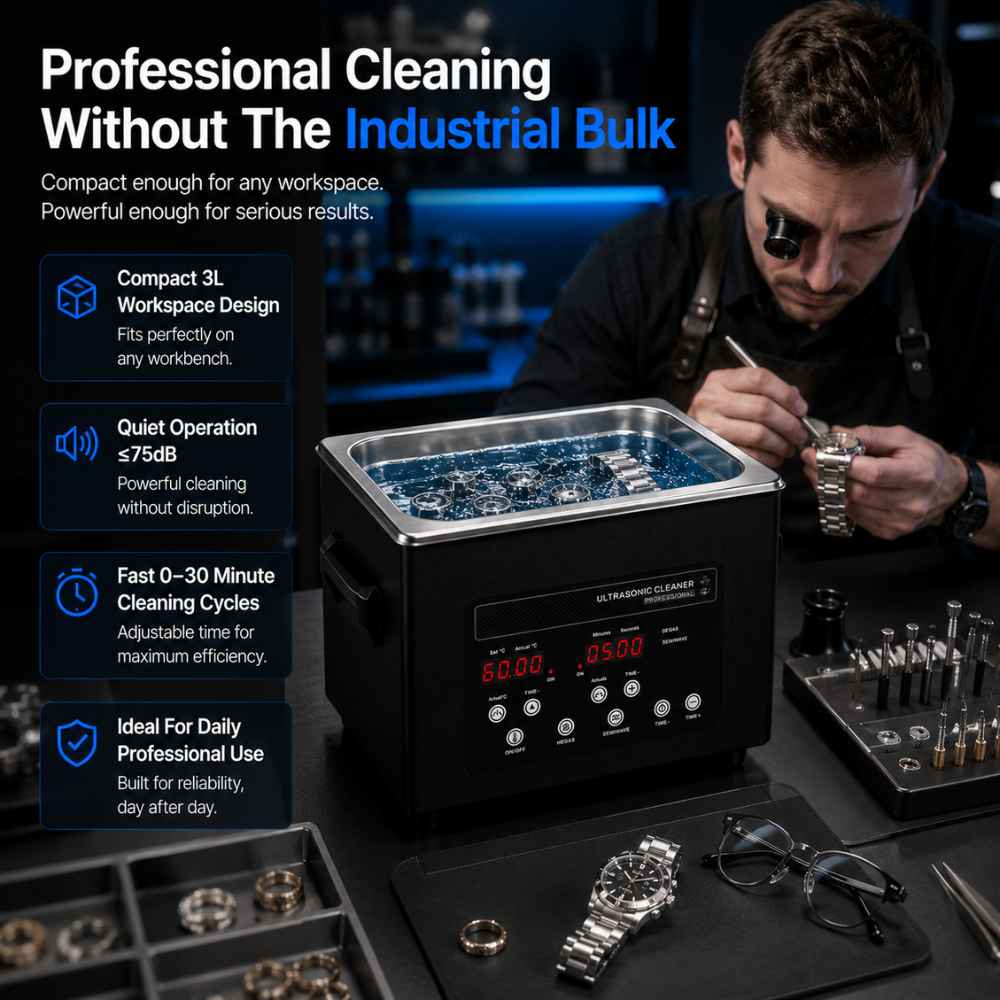
The first decision on the SonicTitan 3L is not which button to press. It is what the item in the basket actually needs from the bath. The digital control panel displays set temperature and actual bath temperature simultaneously in red LED digits, which means you can confirm the solution has reached your target before committing to the cycle.
For stone-set jewelry or coated eyeglass lenses, semiwave mode at 35 to 45°C is the correct starting point: half-power cavitation agitates the solution without generating the pressure that can shift a prong-set stone or degrade an anti-reflective coating. For metal-only parts, watch link joints, or small carburetor components, full 40kHz power at 50 to 65°C dissolves grease and skin-oil deposits faster than any cold cycle at any power level.
Setting the timer anywhere from 1 to 30 minutes and pressing start is the last step, not the first. The unit runs unsupervised from that point.
How to Get a Clean Result on the First Cycle
- 1 Fill the tank to the marked line, not to the rim. Overfilling reduces cavitation intensity at the surface and increases solution splatter during the degas phase. For jewelry and watch parts, a standard dishwashing detergent diluted in warm water is a functional starting solution. For carburetors and mechanical parts, a dedicated ultrasonic degreaser concentrate at the manufacturer ratio performs significantly better.
- 2 Set the target temperature and wait for the actual readout to match before adding items. The dual LED display shows both the set value and the measured bath temperature in real time. Loading items into a bath that has not yet reached temperature shortens the effective cleaning time and produces inconsistent results across batches.
- 3 Run degas mode for 90 seconds before any cycle involving items with blind holes or recessed channels. This applies to carburetor jets, engraved jewelry, threaded fittings, and any part where the geometry traps air. Skipping degas on these items produces a surface-clean result with contamination remaining in the deepest passages.
- 4 Select semiwave for coated, adhesive-set, or stone-set items. Use full 40kHz power for bare metal only. The semiwave mode halves transducer output while maintaining the set temperature, producing agitation sufficient for surface-level cleaning without the cavitation pressure that can stress prong tension, delaminate coatings, or loosen adhesive settings in vintage pieces.
- 5 Drain and change the solution before switching between material types. Cleaning carburetor parts leaves hydrocarbon residue in suspension. Running jewelry through contaminated solution deposits that residue on polished surfaces. The integrated drain tube on the SonicTitan 3L empties the tank in under two minutes without tilting or lifting a full bath.
After the 3L Sonic Bath, What a Complete Cycle Leaves Behind and When to Run Another?
A completed cycle in the SonicTitan 3L leaves the solution visibly darker when the contamination load was high, which is the most direct confirmation that cavitation transferred the deposit from the item to the bath rather than redistributing it.
Items that come out with residue in a specific zone, typically a recessed thread or a deep engraving channel, indicate an air pocket that the degas cycle did not fully clear, usually because the item entered the bath too quickly after filling and the solution was still saturated. The fix is a 90-second degas-only run before the next cleaning cycle.
The integrated drain at the base of the unit simplifies solution changes between item types: removing cleaning solution before introducing jewelry after a carburetor run is a matter of positioning the drainage tube rather than tilting a full tank. At 3 liters, solution consumption per cycle is low enough that changing baths between material types is practical rather than costly, which is what makes this tank volume functional for a mixed workbench rather than a single-material production line.
Each Step of the Process Has a Setting, The Panel Gives You Control Over All of Them:
When the item on your bench requires precision at every stage of cleaning rather than volume, the 3L heated format with independent mode and temperature control covers the full sequence from degas to rinse. See the full ultrasonic cleaner range to compare capacities, or explore the industrial ultrasonic cleaner options if your batch size has grown past what a 3-liter bath can handle in a single run.
Share


FAQ - Ultrasonic cleaner
What is an ultrasonic cleaner and how does cavitation work?
An ultrasonic cleaner uses a transducer to project high-frequency sound waves (typically 40 kHz) through a liquid bath. Those waves create and collapse millions of microscopic bubbles per second a process called acoustic cavitation. Each collapse generates a localized pressure jet that physically dislodges contaminants from every surface it reaches, including recesses, hinge barrels, prong settings, and blind holes that no brush can access.
The result is a contact-free clean that outperforms manual methods in both speed and thoroughness. A professional jeweler in Denver running an ultrasonic tank for 4 minutes on a gold ring pulls out more skin oil and lotion residue than 10 minutes of brushing could reach not because the machine is more powerful, but because cavitation reaches geometry that bristles physically cannot.
How long does an ultrasonic cleaning cycle take?
Cycle time depends on material and soil type, not machine power alone. Defaulting to the longest cycle is not safer over-cycling at elevated temperature can damage coatings and loosen adhesive-held components on items that were otherwise compatible.
Glasses (light soiling) : 2–4 min 50°C
Gold / platinum jewelry : 3–6 min 60°C
Retainer / aligner (mineral deposits) : 5–8 min 45°C
Watch bracelet (no movement) 5–8 min 50°C
Dental instruments : 10–15 min 60°C
Gun parts (carbon fouling) : 15–20 min 60°C
Carburetor bodies : 15–20 min 65°C
How do I contact Sonirity support?
📧 contact.sonirity@gmail.com
For product selection guidance, order questions, returns, and technical troubleshooting. For fastest response on product compatibility questions, include the item you're trying to clean and the model you're considering, Owen reviews all technical inquiries personally.