

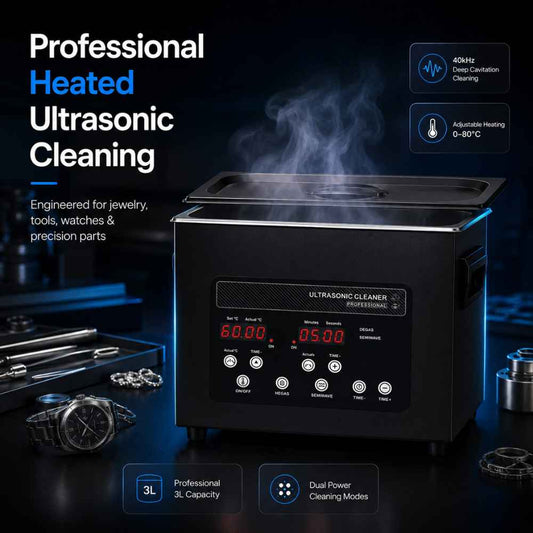

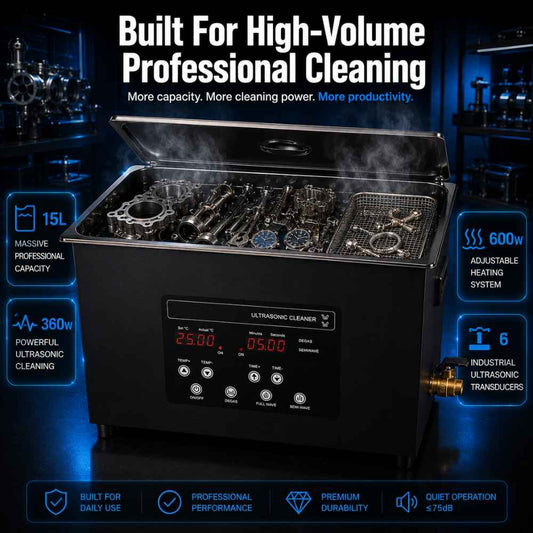

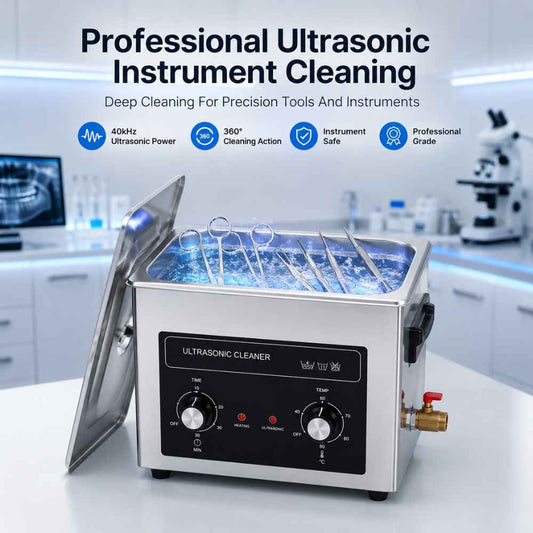

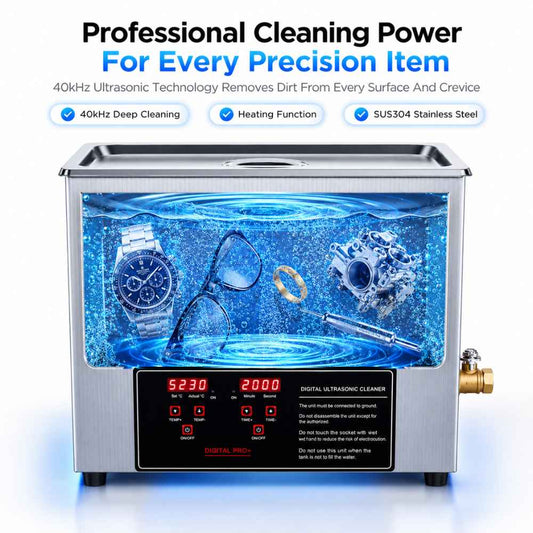

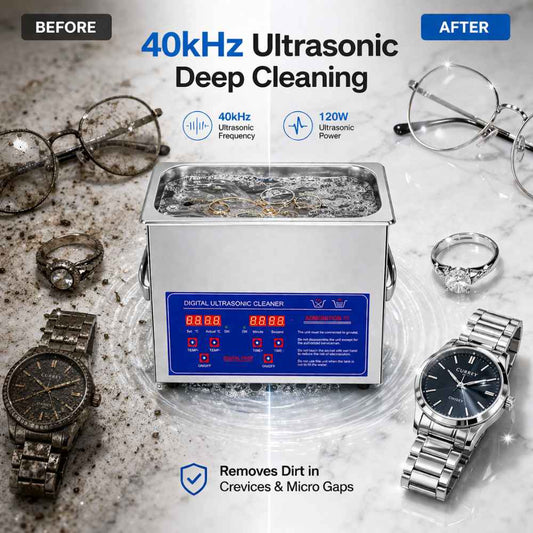

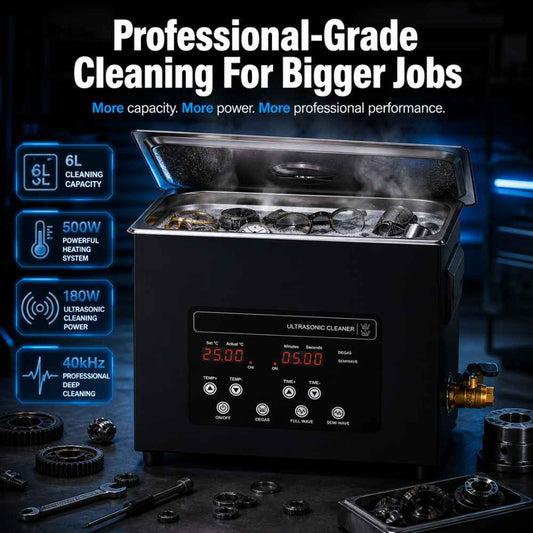

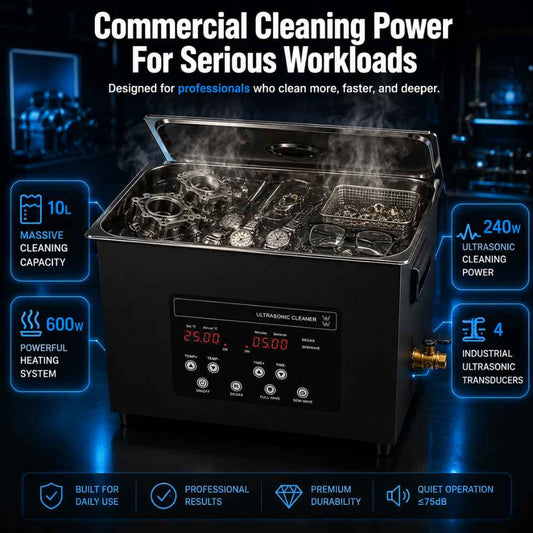
If you're pulling grease-packed bearings, carbon-fouled bolt carrier groups, or varnish-caked injectors off a workbench, a general-purpose cleaner won't cut it. These tanks run at 40 kHz with a minimum 10 W/L watt density, enough cavitation energy to reach blind holes, threaded recesses, and internal passages that a brush never touches. Pick your tank size, drop in your parts, and let the physics do the work.
Spec-checked against ASTM F2867-22, Updated June 2026
What Separates a Parts Cleaner from a Standard Ultrasonic Bath:
A parts-specific ultrasonic cleaner is sized and powered for mechanical geometry: blind holes, threaded ports, recessed cavities, and internal channels that trap contaminants. The 10 W/L watt density floor is what separates a true parts cleaner from a lighter consumer bath: below that threshold, you're soaking the part, not stripping it. The parts basket matters too: a rigid stainless mesh holder suspends components so the cleaning field reaches all faces simultaneously, not just the side resting on the tank floor.

Say you're running a set of throttle body components after a 15-minute soak at 40 kHz and 55°C: the difference between a 6 W/L tank and a 12 W/L tank on a carbon-fouled aluminum bore is visible with the naked eye after the first cycle. The physics behind that gap are covered in the how ultrasonic cleaners work guide, worth reading before you spec your unit.
| Tank Size | Typical Parts Load | Cycle Time | Best For |
|---|---|---|---|
| 3L | Single carb body, small BCG, 4-6 bearings | 10-15 min | Hobbyist shop, occasional maintenance, single-part runs |
| 6L | Full carburetor set, pistol frame + slide, valve train components | 15-20 min | Semi-pro shop, gunsmith bench, light automotive work |
| 10L+ | Cylinder heads, intake manifolds, multi-part batches | 20-30 min | Production shop, multi-batch daily cleaning, larger assemblies |
What You Can Clean with an Ultrasonic Parts Cleaner
These units are built for the mechanical parts that accumulate the hardest contamination: bolt carrier groups, injectors, valve train components, wheel bearings, throttle bodies, and brake caliper pistons. Carburetors clean well in a 6L tank at 40 kHz with an appropriate aqueous degreaser. Steel, hardened steel, and aluminum are all compatible at standard operating temperatures, for a full breakdown of material compatibility by part type, see the complete material compatibility guide.
Every tank in this collection is sized and rated for mechanical parts cleaning.
Choosing the Right Tank Ultrasonic parts cleaner for Your Shop:
Tank volume and watt density are the two numbers that determine whether a cycle actually works. For metal parts with recessed geometry, 10 W/L is the floor, go below that and you're soaking, not cavitating. A built-in heater matters for carbon and varnish removal: running at 50-60°C reduces cycle time by 30-40% on heavily fouled parts compared to room-temperature operation. If you're cleaning aluminum castings or anodized components, keep temperature under 60°C to protect surface finish.
A failed injector cleaning pass that requires a shop re-clean and re-test typically runs $80-150 on a 4-cylinder set. Buying a tank with insufficient watt density and repeating cycles costs more in time and chemistry than the price difference between a 6 W/L and a 12 W/L unit. That's why a good ultrasonic parts cleaner or industrial ultrasonic cleaner could be the best for you.
Pro Tip from a Ultrasonic Cleaning Specialist: Run a degassing cycle for 5-7 minutes before your first cleaning pass on a new tank or fresh solution. Trapped air in the liquid suppresses cavitation intensity by up to 20% in the first cycle. On a 6L tank at 40 kHz, that degassing step alone makes the difference between a part that needs a second pass and one that comes out clean the first time.
Which Tank Do You Need?
- Cleaning parts with blind holes, threads, or internal passages? Yes: prioritize a tank with degassing mode and sweep frequency. No: a standard 40 kHz fixed-frequency unit works.
- Parts larger than a single carburetor body? Yes: 6L tank minimum required to fully submerge the part and maintain cavitation field. No: a 3L tank handles it.
- Running multiple batches per day? Yes: choose a unit with built-in heater and digital timer to maintain consistent cycle temperature across batches. No: a basic single-cycle unit is sufficient.
FAQ about Ultrasonic parts cleaner:
What is an ultrasonic parts cleaner used for?
An ultrasonic parts cleaner uses 40 kHz sound waves to generate cavitation bubbles that dislodge grease, carbon, varnish, and metal particles from mechanical components. It handles parts with complex geometry where brushes and spray washers cannot reach: threaded bores, blind holes, valve seats, bearing races, and internal passages. A standard cycle runs 10-20 minutes at 40-60°C depending on contamination level and material. It is the tool of choice for gunsmith benches, small automotive shops, bicycle service stations, and precision maintenance work across the US.
Can I clean gun parts with an ultrasonic parts cleaner?
Yes, an ultrasonic parts cleaner is effective for cleaning steel and aluminum firearm components including bolt carrier groups, trigger assemblies, and barrel exteriors. Use an aqueous degreaser rated for firearms and run a 15-20 minute cycle at 40 kHz. Note that US state laws vary regarding gunsmithing activities and the use of solvents in commercial settings: verify local regulations before operating a cleaning service on firearms for third parties. Rubber or polymer components should be removed before the cycle.
What tank size do I need for automotive parts?
A 6L tank covers most individual automotive parts including carburetor bodies, injectors, throttle bodies, and valve train components. For cylinder heads, intake manifolds, or multi-part batches, a 10L+ tank is required to fully submerge the part and maintain an active cavitation field across the entire surface. Cleaning a partial load in an oversized tank wastes chemistry; cleaning an oversized part in a small tank produces incomplete results on the sections above the solution line.
Is an ultrasonic parts cleaner safe for aluminum and steel?
40 kHz ultrasonic cleaning is safe for hardened steel, mild steel, and aluminum alloys when operated at temperatures below 60°C with a pH-neutral or mildly alkaline aqueous solution. Cast iron and stainless steel are also compatible. Uncoated brass tolerates ultrasonic cleaning but requires shorter cycles (under 10 minutes) at lower temperatures to prevent surface dulling. Untreated copper and soft soldered assemblies need manual inspection before submersion. Anodized aluminum surfaces hold up well under standard cycle parameters.
Every tank here ships ready to run: rated watt density, correct frequency, stainless basket included.