


Sonirity
6L Ultrasonic cleaner | SonicTitan
6L Ultrasonic cleaner | SonicTitan
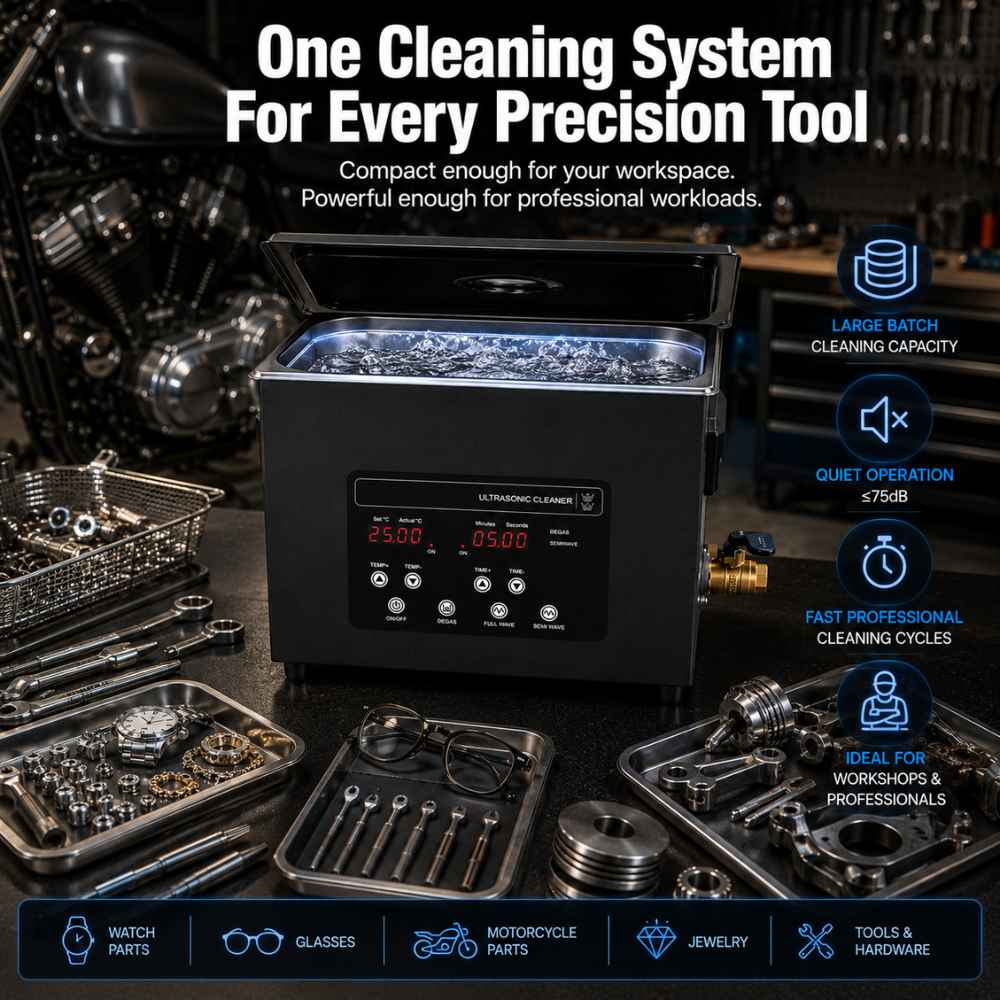
☑️ Cleans What Cloths Can't Reach
☑️ Ultrasonic Cavitation Technology
☑️ Auto Shut-Off, No Over-Cleaning
☑️ Results in Minutes, No Scrubbing
Couldn't load pickup availability
Is a 6-Liter Ultrasonic Tank the Right Volume for Carburetor Bodies and Workshop Batches?
Six liters is the volume where a full carburetor body, including float bowl and choke assembly, submerges completely without touching the tank walls, which is the first condition for even cavitation across the entire external surface. A 3L bath forces most carburetor bodies in at an angle or in pieces, which means one face of the casting cleans while the other stays above the solution line. At 6L, a standard motorcycle carburetor or a twin-barrel automotive unit lays flat on the basket, fully immersed, with clearance on all sides.
That geometry matters because cavitation intensity drops sharply at the solution surface: any portion of the item that breaks the surface line receives no cleaning energy at all. The 6L tank resolves that problem for parts up to approximately 250mm in length without requiring disassembly before cleaning, which is where the time saving becomes concrete rather than theoretical.
Where the 6-Liter Tank Covers Ground the 3L Cannot
- ● Full carburetor bodies up to 250mm: Motorcycle carbs, twin-barrel automotive units, and small engine carburetors submerge completely in the 6L basket. Degas mode at 55–65°C followed by full 40kHz power for 15 minutes clears float bowl varnish, emulsion tube buildup, and pilot jet deposits without disassembly.
- ● Full instrument trays for dental or surgical pre-cleaning: A standard cassette of scalers, explorers, curettes, and mirrors fits the 6L basket in a single load. Semiwave mode at 45°C with enzymatic solution removes dried biofilm and debris from serrations and hinge joints in 10 minutes, consistent with pre-autoclave preparation workflows.
- ● Jewelry batches of 8 to 15 pieces per cycle: Mixed loads of rings, bracelets, and pendants clean simultaneously in semiwave mode at 40°C. The 6L solution volume dilutes skin oils and polish compound across the full batch without saturating the bath before the cycle ends, which extends usable solution life compared to a 3L fill running the same load in two passes.
- ● Injector sets and fuel system components: A set of four fuel injectors lays flat in the basket with room for associated O-ring carriers and filter baskets. Full 40kHz power at 60°C in a compatible ultrasonic cleaner solution removes varnish deposits from injector pintle housings and internal screens in 10 to 20 minutes.
- ● Eyeglass frames in optical practice end-of-day processing: Six to eight frames process simultaneously in semiwave mode at 35°C. The larger bath volume keeps solution temperature stable across consecutive loads without the thermal drop that occurs in a 3L tank when cold frames enter a small heated bath repeatedly within the same session.
- ● PCB assemblies and electronic subassemblies up to 200mm: Boards and connector assemblies that exceed the 3L basket footprint fit flat in the 6L tank. Full 40kHz power at 45°C in isopropyl or aqueous cleaning solution removes flux residue from under BGA packages and between connector pins in 5 to 10 minutes without mechanical contact.
Can the Same 6-Liter Sonic Bath That Cleans Carburetor Castings Also Handle Dental Instruments or Jewelry Batches?
The semiwave mode on the SonicTitan 6L halves the transducer output while maintaining the set bath temperature, which creates a cleaning environment aggressive enough to remove biofilm from dental instrument serrations and skin-oil deposits from jewelry surfaces without generating the cavitation pressure that damages polished finishes, loosens stone settings, or stresses the hinge mechanisms on articulated instruments.
A 6L tank in semiwave mode at 45°C processes a full tray of scalers, explorers, and mirror handles simultaneously, which is a load that a 3L bath handles only across two separate cycles. The physical separation between material types is managed through solution changes via the drain valve rather than through any hardware limitation: the same tank that runs a degreaser concentrate at 65°C for carburetor work in the morning runs an enzymatic solution at 45°C for instrument pre-cleaning in the afternoon, provided the drain-and-refill step is completed between sessions.
The basket insert keeps all items suspended off the tank floor regardless of mode, which is the correct position for semiwave cleaning because floor-contact items experience localized high-intensity cavitation that the semiwave setting is specifically designed to moderate.
Where Does a 6-Liter Ultrasonic Cleaner Outperform a 3L, and When Does a 10L Become Necessary?
The 6L format outperforms the 3L in three specific conditions: when the item being cleaned exceeds approximately 180mm in any dimension and cannot be partially submerged; when the session involves consecutive batches of the same item type, where a larger solution volume dilutes contamination more slowly and extends the usable life of each bath fill; and when throughput per hour matters, because a 6L basket holds more items per cycle than a 3L basket without requiring the operator to choose between cleaning coverage and load size.
The crossover toward a 10L tank begins when the workflow involves parts longer than approximately 250mm, full carburetor assemblies with intake manifold sections attached, or production volumes where cleaning 10 or more units per session is routine rather than occasional. For a one- to three-unit per session workshop, a small optical practice, or a mixed-use bench that alternates between jewelry, instruments, and mechanical parts across a working day, the 6L sits at the intersection of adequate volume and practical operating cost: smaller solution fills, faster heat-up time, and a form factor that does not require a dedicated bench position.
When the Part Fits the Tank and the Tank Fits the Bench, the Workflow Follows?
For workshop loads where 3L runs short and 10L exceeds what a single-operator bench produces in a day, the 6L heated format with independent mode and temperature control covers the full range of daily cleaning tasks without a change in hardware. Browse the entire collection of ultrasonic cleaner to compare capacities across the lineup, or explore the industrial ultrasonic cleaner options for production volumes that a 6L bath cannot cover in a single cycle.
Share


FAQ - Ultrasonic cleaner
What is an ultrasonic cleaner and how does cavitation work?
An ultrasonic cleaner uses a transducer to project high-frequency sound waves (typically 40 kHz) through a liquid bath. Those waves create and collapse millions of microscopic bubbles per second a process called acoustic cavitation. Each collapse generates a localized pressure jet that physically dislodges contaminants from every surface it reaches, including recesses, hinge barrels, prong settings, and blind holes that no brush can access.
The result is a contact-free clean that outperforms manual methods in both speed and thoroughness. A professional jeweler in Denver running an ultrasonic tank for 4 minutes on a gold ring pulls out more skin oil and lotion residue than 10 minutes of brushing could reach not because the machine is more powerful, but because cavitation reaches geometry that bristles physically cannot.
How long does an ultrasonic cleaning cycle take?
Cycle time depends on material and soil type, not machine power alone. Defaulting to the longest cycle is not safer over-cycling at elevated temperature can damage coatings and loosen adhesive-held components on items that were otherwise compatible.
Glasses (light soiling) : 2–4 min 50°C
Gold / platinum jewelry : 3–6 min 60°C
Retainer / aligner (mineral deposits) : 5–8 min 45°C
Watch bracelet (no movement) 5–8 min 50°C
Dental instruments : 10–15 min 60°C
Gun parts (carbon fouling) : 15–20 min 60°C
Carburetor bodies : 15–20 min 65°C
How do I contact Sonirity support?
📧 contact.sonirity@gmail.com
For product selection guidance, order questions, returns, and technical troubleshooting. For fastest response on product compatibility questions, include the item you're trying to clean and the model you're considering, Owen reviews all technical inquiries personally.