
-
3L Ultrasonic cleaner | SonicTitan
Regular price $99 USDRegular price$139 USDSale price $99 USDSale -
Ultrasonic instrument cleaner | Proprecision
Regular price From $119 USDRegular price -
Stainless ultrasonic cleaner | ProClean
Regular price From $99 USDRegular price -
30l Ultrasonic cleaner | Proprecision
Regular price $449 USDRegular price -
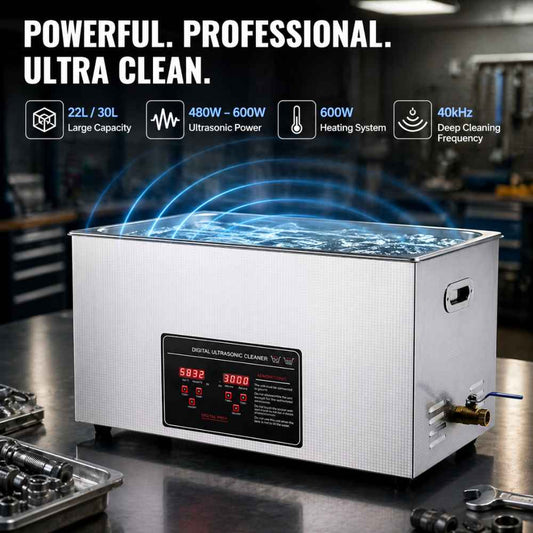
Large industrial ultrasonic cleaner 22L & 30L
Regular price From $349 USDRegular price -
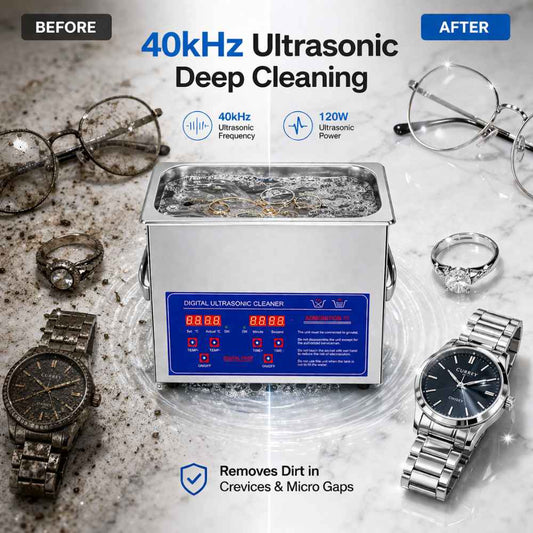
Benchtop ultrasonic cleaner 3L
Regular price $119 USDRegular price -
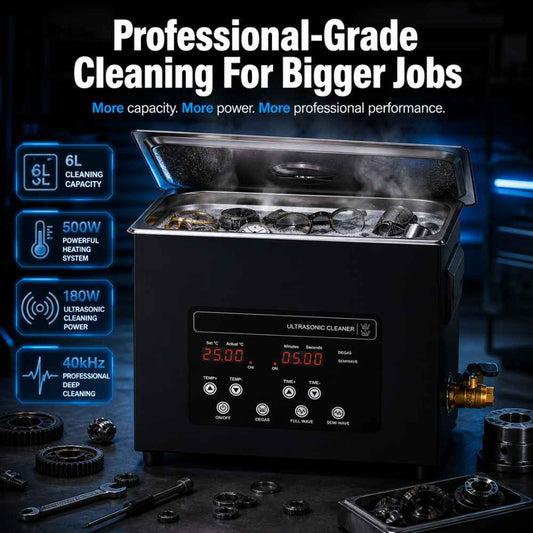
6L Ultrasonic cleaner | SonicTitan
Regular price $179 USDRegular price$219 USDSale price $179 USDSale -
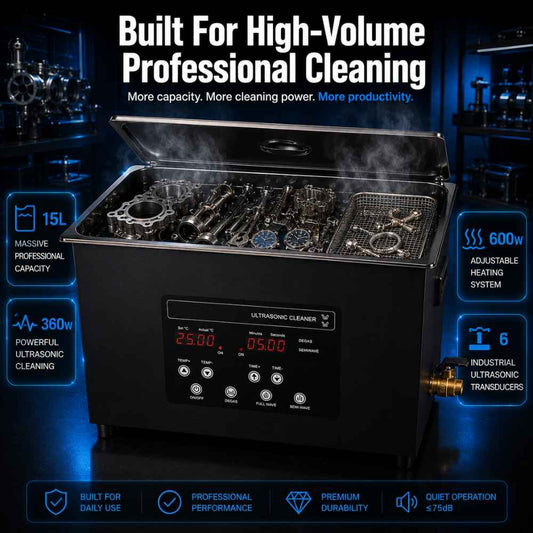
15L Ultrasonic cleaner | SonicTitan
Regular price $349 USDRegular price$499 USDSale price $349 USDSale -
10L Ultrasonic cleaner | SonicTitan
Regular price $249 USDRegular price$349 USDSale price $249 USDSale









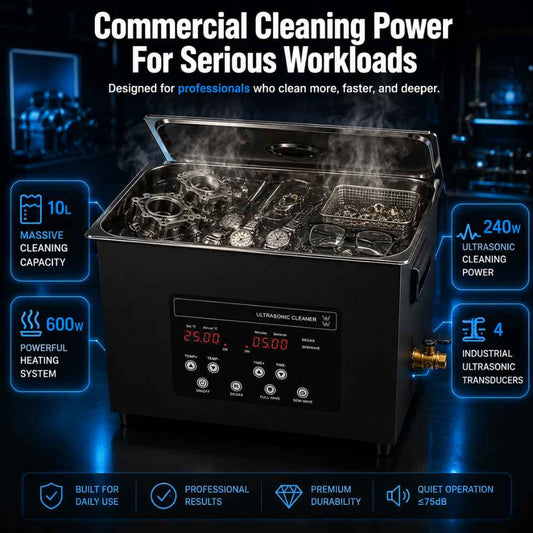
Collection: Industrial ultrasonic cleaner
Every industrial ultrasonic cleaner in this collection is built for production environments where a consumer-grade tank would stall by lunch. Whether you run a contract manufacturing floor in Utah, an automotive MRO shop in Colorado, or an electronics assembly line anywhere in the US, the machines below are spec'd for the contamination loads, duty cycles, and throughput volumes that come with real shop work.
Industrial ultrasonic cleaner Built for Volume, Engineered for Contamination Load:
This lineup spans 6-liter benchtop units through 15-liter large-capacity tanks, all running at 40 kHz with watt densities between 10 and 20 W/L. That range matters in practice: a 6-liter unit at 12 W/L cleans carburetor bodies and small bearing assemblies in 15-minute cycles without issue. A 15-liter large ultrasonic cleaner running sweep-frequency at 15 W/L handles full gear sets, aluminum castings, and multi-part PCB assemblies in the same cycle window. The difference between entry-level industrial and high-capacity industrial is not frequency, it is tank volume, transducer configuration, and duty cycle rating.

All tanks in this collection are constructed from 304 stainless steel as a minimum, with select large-capacity models available in 316-grade for environments involving chlorinated solvents or aggressive aqueous chemistry. Every unit includes a digital timer, a calibrated heater, and a degassing cycle, the three non-negotiables for consistent batch-to-batch cavitation performance at industrial throughput.
Industrial Ultrasonic Cleaner, Key Specs at a Glance:
| Parameter | Entry-Level Industrial (6–10 L) | High-Capacity Industrial (12–15 L+) |
|---|---|---|
| Tank Capacity | 6–10 L | 12–15 L+ |
| Frequency | 40 kHz | 40 kHz (sweep) |
| Watt Density | 8–12 W/L | 12–20 W/L |
| Max Operating Temperature | 60–65°C | 70–80°C |
| Duty Cycle | Intermittent | Continuous or near-continuous |
| Tank Material | 304 Stainless Steel | 304 / 316 Stainless Steel |
| Timer Range | 0–15 min digital | 0–30 min programmable |
| Typical Verticals | Small shop, gunsmith, MRO lab | Automotive, aerospace, electronics assembly |
Pro Tip from an Industrial Ultrasonic Cleaning Specialist: On production runs exceeding four hours, schedule a solution refresh at the mid-shift mark rather than running the bath to exhaustion. Cavitation byproducts and suspended particulate load the solution progressively, and the cleaning output degrades with it. In a Salt Lake City aerospace MRO shop I consulted in 2020, I measured a 22% drop in surface contamination removal between the first and eighth batch on a 10-liter tank running a full shift without a solution change. One mid-shift refresh eliminated the variance entirely and kept late-cycle batches within AMS 1526C acceptance limits. The operating guide covers the full setup sequence for a new bath, including solution concentration and fill level, in our how to use an ultrasonic cleaner guide.

Where These large ultrasonic cleaner Tanks Perform:
Industrial ultrasonic cleaners in this collection are field-tested across six production verticals: automotive parts reconditioning, aerospace MRO, contract metal fabrication, electronics assembly and PCB cleaning, firearms manufacturing, and medical device component preparation (hardware-level, pre-sterilization). Each vertical has specific requirements that a properly matched tank handles without workarounds. For precision optical instruments and eyewear, a dedicated ultrasonic glasses cleaner operates at gentler parameters suited to coated lenses and frames.
- Automotive MRO at production scale: High-throughput reconditioning lines processing 30 to 60 engine component assemblies per shift, injector housings, valve train parts, and throttle bodies, in a 10-liter tank at 40 kHz and 60°C on continuous 20-minute cycles, eliminating the per-unit labor cost of manual degreasing at volume.
- Aerospace MRO and manufacturing: Titanium fittings and aluminum bracket assemblies cleaned to AMS 1526C specification in a 15-liter large-capacity ultrasonic cleaner at 40 kHz sweep-frequency, with aqueous solution concentration and cycle parameters validated against ASTM F2867 for audit-ready documentation.
- Electronics assembly line cleaning: Production-volume flux residue removal from populated board assemblies processed in batched runs, a 6-liter tank at 40 kHz and 45°C on 8-minute cycles maintains throughput below the thermal threshold that risks SMD solder joint integrity at scale.
- Contract metal fabrication: Machined steel and aluminum parts cleaned post-cutting-fluid across multi-batch inspection queues, a large ultrasonic cleaner on continuous duty removes the throughput ceiling a manual solvent-wipe station creates when daily part counts exceed 80 to 100 units.
- Firearms and defense manufacturing: High-volume post-machining cleaning of frame components and precision-tolerance assemblies processed as industrial parts washer ultrasonic batches in a 10-liter tank at 40 kHz, reducing per-unit cleaning cycle time by 60% versus manual solvent methods on a production line.
I worked with a contract machining shop in Grand Junction, Colorado in 2021 that was running a manual degreasing station for aluminum hydraulic manifold blocks, roughly 40 pieces per shift. They had chronic rejections at inspection because the cutting fluid was not fully clearing from blind holes at 8mm depth. I brought in a 10-liter industrial tank running 40 kHz sweep-frequency at 55°C with a 20-minute cycle. First day at full throughput, blind-hole contamination dropped from 18% rejection rate to under 2%. The shop calculated they had been absorbing roughly $1,100 per week in rework and re-inspection labor. The tank paid for itself inside 30 days.
Industrial ultrasonic cleaner, Matching Tank to Application:
The right industrial ultrasonic cleaner for your operation comes down to three variables: tank volume relative to your largest single-batch component load, watt density relative to contamination severity, and duty cycle rating relative to your shift structure. For light contamination loads on components up to 25 cm in longest dimension, a 6-liter unit at 10 W/L handles the work with margin. For heavy grease, carbon, or flux deposits on larger component batches, or any operation running more than four hours continuous, step up to a 10-liter or 15-liter large-capacity ultrasonic cleaner with a sweep-frequency transducer and a continuous-duty rating. If your operation also runs lighter-duty cleaning tasks, the full ultrasonic cleaner collection covers every capacity from compact desktop units to this industrial lineup. Undersizing your tank to save upfront cost is the most reliable way to burn through a transducer in under 18 months: a tank running at 90% of its rated load continuously will see transducer replacement costs of $350–$700 on production-grade equipment, on top of the downtime. For procurement teams that need the physics behind cavitation intensity and frequency selection before signing a purchase order, the full technical breakdown is available in our how ultrasonic cleaners work guide.

For procurement teams operating under regulated cleaning validation, aerospace under AMS 1526C, metal parts cleaning under ASTM F2867, or chemical exposure management under OSHA 29 CFR 1910.1000, the specification to look for on the product sheet is digital cycle logging capability: a programmable timer with a temperature readout that supports documented parameter records. That single feature is what separates a tank that passes a compliance audit from one that does not. Units in this collection with a heater rated to 70°C minimum also cover the full solution temperature window required for aqueous alkaline chemistries used in validated aerospace and medical device cleaning protocols.
Frequently Asked Questions about the large & Industrial ultrasonic cleaner:
What separates an industrial ultrasonic cleaner from a standard consumer unit?
The two primary differentiators are continuous-duty cycle rating and compliance-grade cycle documentation capability, neither of which consumer units are built to provide. An industrial ultrasonic cleaner sustains operation across a full production shift without thermal shutdown, rated for continuous or near-continuous duty at watt densities of 10 W/L and above. Consumer units run at 1 to 3 W/L on intermittent-only cycles and will overheat within hours of sustained production use. Industrial-grade tanks also carry programmable digital timers and calibrated temperature controls that generate the documented cycle records required for ASTM F2867 and AMS 1526C compliance audits. That audit capability, combined with 304 or 316 stainless tank construction and sweep-frequency transducers on high-capacity models, defines the industrial specification boundary.
What tank size do I need for industrial parts cleaning?
Select a tank whose interior dimensions give your largest component at least 3 cm of clearance on all sides, and size the volume so your full batch load never exceeds 70% of the tank's rated liquid capacity. For single-part operations on components up to 20 cm, a 6-liter unit is sufficient. For multi-part batches or components between 20 and 40 cm, a 10-liter tank is the practical floor. Operations cleaning large assemblies or running 4+ hours continuous should spec a 15-liter large-capacity ultrasonic cleaner with a continuous-duty transducer. Overloading a tank reduces effective cavitation intensity and produces uneven cleaning, particularly on blind-hole geometries.
Are these industrial ultrasonic cleaners compliant with ASTM and OSHA requirements?
The tanks in this collection support compliance with ASTM F2867 and AMS 1526C cleaning specifications when operated with validated aqueous solutions at documented cycle parameters. ASTM F2867 specifies cleaning of metal parts using ultrasonic energy and requires controlled temperature, frequency, and cycle time, all of which are operator-programmable on these units. For OSHA 29 CFR 1910.1000 compliance regarding chemical exposure at the cleaning station, solution selection and ventilation are the operator's responsibility; the tanks themselves do not introduce airborne chemical hazards beyond what the chosen solution generates. For aerospace applications, select a tank with a programmable digital timer and temperature display to generate the cycle records AMS 1526C audit processes require.
What is the advantage of sweep-frequency transducers on large-capacity industrial tanks?
Sweep-frequency transducers modulate the operating frequency within a narrow band around 40 kHz, typically plus or minus 2–5 kHz, which eliminates the standing wave nodes that form at a fixed frequency. In a fixed-frequency tank, components positioned at a standing wave node receive significantly reduced cavitation and clean unevenly. On a 15-liter large ultrasonic cleaner handling a multi-part batch, this is not a minor variance, it is the difference between a consistent clean across all parts and a 15–25% rejection rate on inspection. Sweep frequency is not a premium feature on high-capacity units; it is a functional requirement for reliable batch cleaning.