


Sonirity
Digital ultrasonic cleaner | SmartClean
Digital ultrasonic cleaner | SmartClean
☑️ Cleans What Cloths Can't Reach
☑️ Ultrasonic Cavitation Technology
☑️ Auto Shut-Off, No Over-Cleaning
☑️ Results in Minutes, No Scrubbing
Couldn't load pickup availability
The morning you hold your glasses up to the light and still see smudges after wiping them three times
It starts as a minor irritation: a prescription lens that never quite clears, a ring that stopped catching light the way it did when it was new, a watch bracelet whose clasp feels gritty after a long weekend. The instinct is to wipe harder, use a different cloth, or run the piece under the faucet. None of those approaches address what's actually happening. Skin oil doesn't sit on top of lens coatings, it bonds to them. Grime doesn't rest between jewelry prongs, it packs in. The surface you can touch with your finger isn't where the problem lives.
A sonic jewelry cleaner priced under $20 at a drugstore moves water around. What it doesn't do is generate true cavitation: the rapid nucleation and implosion of microscopic bubbles that creates localized pressure sufficient to dislodge contamination from recessed geometry. The distinction matters because the items people clean most often, glasses, rings, watch bracelets, have their dirtiest surfaces in their hardest-to-reach places. Cavitation reaches there. Motor vibration doesn't. The first time I ran a pair of anti-reflective lenses through a genuine 49kHz cycle, the coating clarity was visibly different from anything a microfiber cloth had produced in two years of daily use.
Three timed cycles, each calibrated to a different contamination load
The difference between a 3-minute pass and a 12-minute cycle is not simply exposure time. At 3 minutes, the 49kHz cavitation field clears surface oils, fresh fingerprints, and light particulate from glasses lenses and jewelry after a normal day of wear. At 12 minutes, sustained cavitation pressure works through the layered contamination that builds over weeks: polishing compound residue in ring settings, skin-oil buildup in watch bracelet links, and mineral deposits in eyeglass nose pad tracks. Selecting the wrong cycle in either direction wastes time or leaves the job unfinished.
Clears daily surface oils, fingerprints, and light smudges from glasses lenses, pendants, and rings after a single day of wear.
The everyday cycle for glasses frames, watch bracelets, and multi-stone jewelry. Removes accumulated skin oils and fine particulates from hinge recesses and link pivots.
Sustained cavitation for pieces not serviced in weeks. Addresses bonded contamination in ring prong channels, clasp mechanisms, denture plate surfaces, and razor head cartridge geometry.
When you actually need a digital ultrasonic cleaner
- Your anti-reflective glasses lenses show hazing after cleaning because lens cloths redistribute skin oil across the coating rather than lifting it off the surface.
- A ring or pendant has lost its brightness between jeweler visits and polishing cloths leave micro-scratches on soft gold or silver while missing the contamination packed into the prong channels.
- A watch bracelet's clasp feels tacky or stiff after daily wear in humid conditions, where sweat salt and skin oil compress into the deployment mechanism's internal geometry.
- Eyeglass nose pad tracks and frame hinges have visible buildup that a cotton swab moves around but a 6-minute 49kHz cycle dissolves and flushes from the recess.
- Dentures or retainers have persistent odor after standard soaking because soaking tablets work on surface biofilm but don't generate the mechanical action needed to clear micro-porous surface contamination.
- A razor head cartridge feels rougher after two weeks because skin cells and shaving gel residue pack between the blades in a geometry that rinsing under water cannot displace.
Why the form factor matters as much as the frequency for daily use
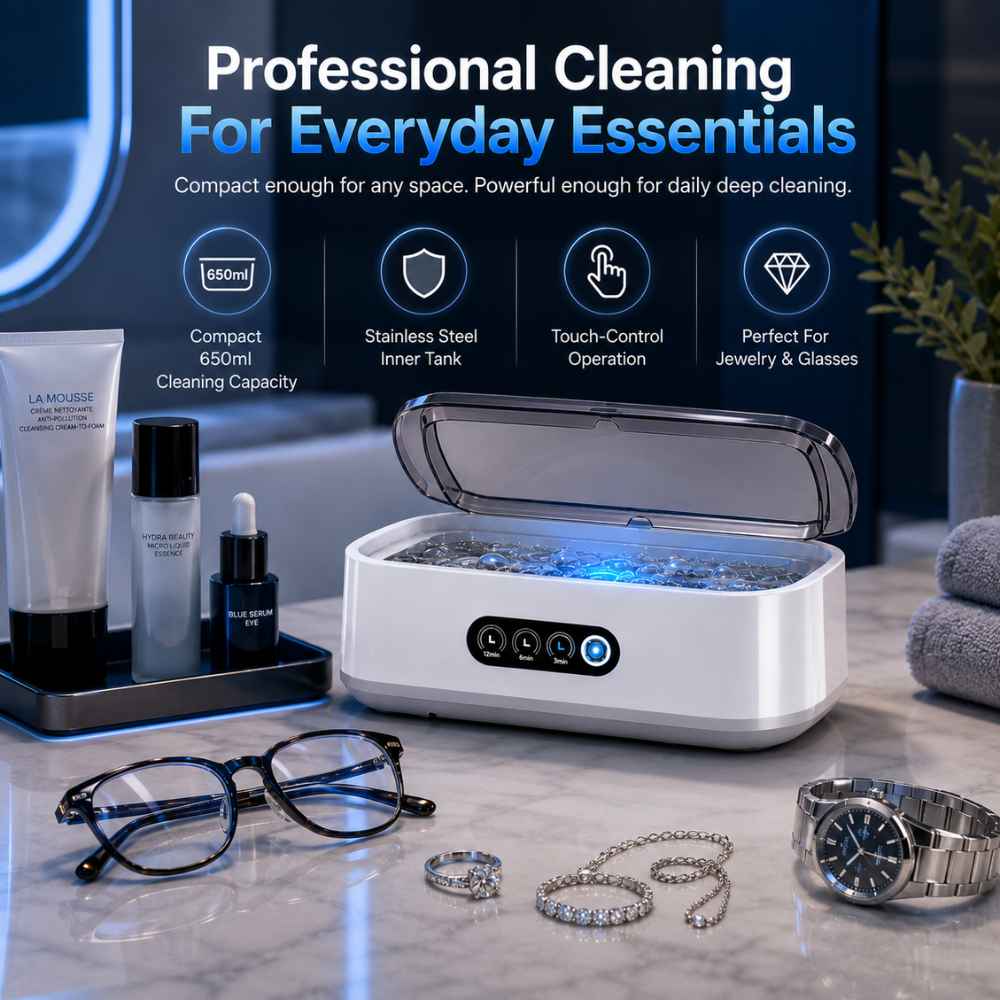
An ultrasonic cleaner that stays in a cabinet gets used once a month. The SmartClean's 650ml tank and ABS housing sit flat on a bathroom counter, dresser, or nightstand without claiming more space than a soap dispenser. The three-button panel on the front face selects the cycle length directly, no menu navigation, no hold sequences. Pressing the button starts the cycle; solid-state automatic shutoff ends it. That operational simplicity is what makes the difference between a device that becomes part of a morning routine and one that doesn't. You also want a product that travels. The compact footprint fits inside a carry-on toiletry kit, which is where glasses and jewelry care is most often neglected.
The acoustic profile is a secondary consideration that becomes relevant in practice. True piezoelectric transducers at 49kHz operate well below the threshold of audible disruption in a bedroom environment. Motor-driven vibration cleaners produce a mechanical rattle that is distinctly audible across a room. Running a 6-minute glasses cycle on a nightstand while someone reads or sleeps nearby is a real use case, and the solid-state construction of this unit makes it viable. Looking for more options in this category? See our full ultrasonic glasses cleaner collection or browse all ultrasonic cleaners.
Full specifications from the manufacturer
- Ultrasonic frequency49 kHz
- Power output18W
- Tank capacity650ml
- Tank material304 Stainless steel / aluminum alloy
- HousingABS
- Cleaning cycles3 min / 6 min / 12 min
- InterfaceOne-touch button panel
- Auto shutoffYes, at cycle end
- CircuitryAdvanced solid-state
- Power plugEU plug (220V)
- US voltage compatibilityNot specified by manufacturer
- In the boxCleaner + User manual + Plug
The smudge that survives every cloth you own has a different solution
Lenses, rings, and bracelets don't get fully clean by hand because the contamination isn't where hands can reach. Three minutes of 49kHz cavitation covers what two years of microfiber cloths won't. The cycle ends on its own. Your glasses will be clearer in the morning than they were the day you picked them up from the optician.
Add the SmartClean to your cartShare


FAQ - Ultrasonic cleaner
What is an ultrasonic cleaner and how does cavitation work?
An ultrasonic cleaner uses a transducer to project high-frequency sound waves (typically 40 kHz) through a liquid bath. Those waves create and collapse millions of microscopic bubbles per second a process called acoustic cavitation. Each collapse generates a localized pressure jet that physically dislodges contaminants from every surface it reaches, including recesses, hinge barrels, prong settings, and blind holes that no brush can access.
The result is a contact-free clean that outperforms manual methods in both speed and thoroughness. A professional jeweler in Denver running an ultrasonic tank for 4 minutes on a gold ring pulls out more skin oil and lotion residue than 10 minutes of brushing could reach not because the machine is more powerful, but because cavitation reaches geometry that bristles physically cannot.
How long does an ultrasonic cleaning cycle take?
Cycle time depends on material and soil type, not machine power alone. Defaulting to the longest cycle is not safer over-cycling at elevated temperature can damage coatings and loosen adhesive-held components on items that were otherwise compatible.
Glasses (light soiling) : 2–4 min 50°C
Gold / platinum jewelry : 3–6 min 60°C
Retainer / aligner (mineral deposits) : 5–8 min 45°C
Watch bracelet (no movement) 5–8 min 50°C
Dental instruments : 10–15 min 60°C
Gun parts (carbon fouling) : 15–20 min 60°C
Carburetor bodies : 15–20 min 65°C
How do I contact Sonirity support?
📧 contact.sonirity@gmail.com
For product selection guidance, order questions, returns, and technical troubleshooting. For fastest response on product compatibility questions, include the item you're trying to clean and the model you're considering, Owen reviews all technical inquiries personally.