


Sonirity
Heated ultrasonic cleaner | SonicTitan
Heated ultrasonic cleaner | SonicTitan
☑️ Cleans What Cloths Can't Reach
☑️ Ultrasonic Cavitation Technology
☑️ Auto Shut-Off, No Over-Cleaning
☑️ Results in Minutes, No Scrubbing
Couldn't load pickup availability
What Changes When You Add Heat to Ultrasonic Cleaning?
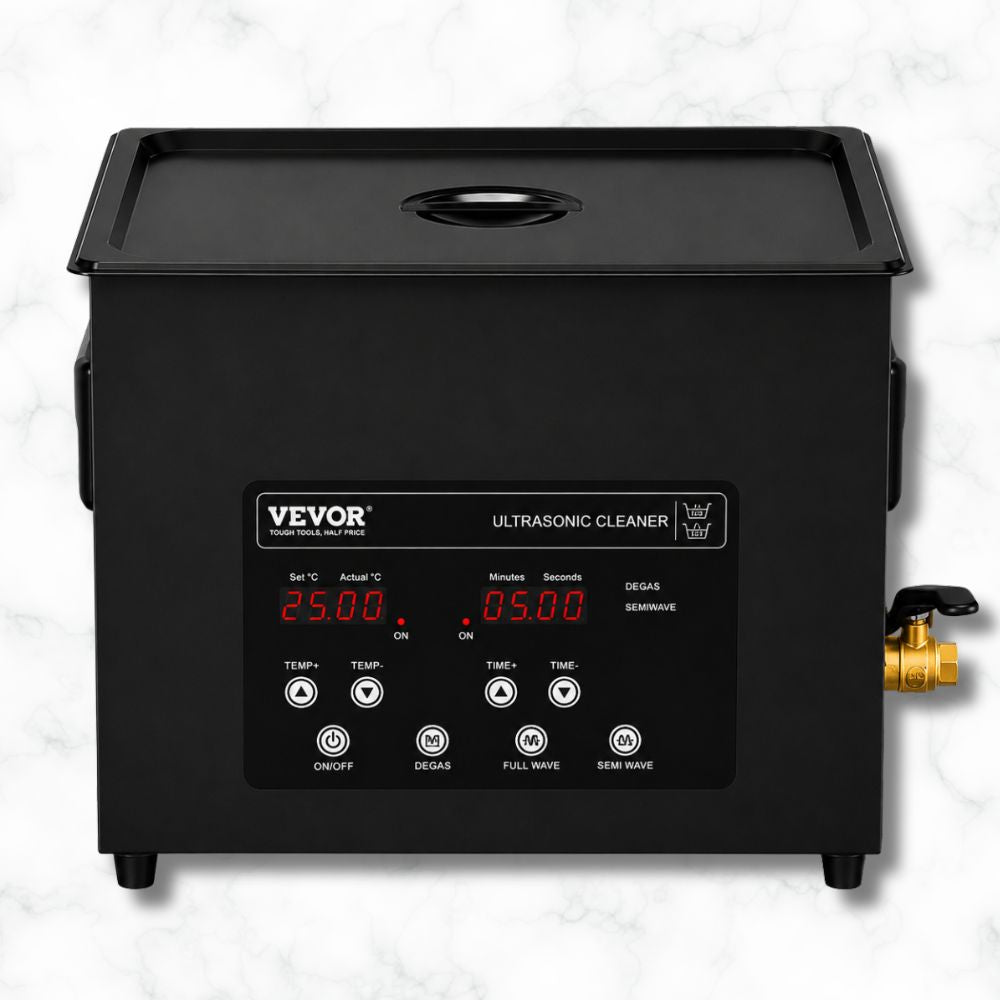
Most ultrasonic cleaners sold at this price point run at room temperature and call it a cycle. The SonicTitan Heated ultrasonic cleaner operates differently: the heating element raises bath temperature from ambient up to 80°C, adjustable in precise increments via the digital control panel, and that single variable changes the chemistry of what gets removed. Grease that resists cold cavitation dissolves at 50°C. Flux residue on circuit boards that takes three cycles unheated clears in one at 60°C. The heat does not act as a shortcut. It acts as a catalyst that lets the 40kHz transducer work on contamination it would otherwise bounce off.
Setting by Situation: What to Select on the Panel
- ● Carburetor jets and fuel galleries: Degas mode first at 55–65°C for 5 minutes, then full power for 10–15 minutes. Removes varnish and carbon from galleries too narrow for any brush.
- ● Circuit boards and PCB connectors: Full 40kHz power at 40–50°C for 3–8 minutes using isopropyl alcohol solution. Lifts flux residue and particulate from under component bodies without mechanical contact.
- ● Jewelry with stone settings or engravings: Semiwave mode at 35–45°C for 3–5 minutes. Reduced cavitation pressure cleans surface oils and tarnish without stressing prong tension or adhesive-set stones.
- ● Watch bracelets and metal straps: Full power at 50°C for 5–10 minutes. Skin oils, dead skin cells, and debris in hinge joints clear in a single cycle without disassembly.
- ● Dental instruments and stainless tools: Full power at 60–70°C for 10 minutes with enzymatic solution. Removes biofilm and dried residue from instrument serrations and hinges, consistent with pre-autoclave preparation workflows.
- ● Eyeglass frames and coated lenses: Semiwave mode at 30–40°C for 2–4 minutes. Low-intensity cavitation reaches nose pad hinges and temple screws without compromising anti-reflective or hydrophobic lens coatings.
How the Degassing Mode Reaches Contamination Trapped at Zero Angle
At 40kHz, this Heated ultrasonic cleaner generates cavitation pressure sufficient to remove carbon deposits, flux residue, and oxidation from precision components in adjustable cycles of 1 to 30 minutes, with a degassing mode that increases cleaning efficiency by 30% by collapsing large air bubbles that would otherwise shield internal crevices from wave penetration. Running carburetor jets through a standard ultrasonic cycle without degassing leaves a residue film inside the smallest galleries because entrained air acts as a buffer. The degassing mode eliminates that buffer first, then switches the transducer to full cleaning power. The first time you disassemble a carburetor body after a degas cycle and find the pilot jet passages clear without a secondary hand-cleaning step, the logic becomes obvious. I have tried both approaches. The difference is not marginal.
Semiwave Mode and the Dual-Power Logic Behind Cleaning Delicate Parts
The SonicTitan Heated ultrasonic cleaner includes a semiwave mode specifically because full 40kHz power at elevated temperature is not always appropriate. A vintage watch movement, a stone-set ring, or a coated optical lens requires a reduced-intensity field that still produces cavitation but at a pressure level that will not loosen adhesive settings or stress micro-engravings. The semiwave setting halves the transducer output while maintaining thermal control, which means the user can select temperature and power independently rather than accepting a single preset. The 304 stainless steel tank, corrosion-resistant against both acidic and alkaline cleaning solutions, is paired with a basket insert that keeps items suspended away from the tank floor, where cavitation intensity peaks and direct contact risk is highest. A portable side handle and integrated drain simplify solution changes between item types without tilting the unit.
Heated ultrasonic cleaner, The Right Setting for What You Are Cleaning Is Already on the Panel:
Carbon in a gallery, oxidation on a contact, grease on a bearing race, or skin oils on a chain link all respond to a different combination of time, temperature, and power level. The digital panel lets you set each variable directly. Choose the capacity that matches your typical load from the full ultrasonic cleaner range or explore the industrial ultrasonic cleaner options for higher-volume applications.
Share


FAQ - Ultrasonic cleaner
What is an ultrasonic cleaner and how does cavitation work?
An ultrasonic cleaner uses a transducer to project high-frequency sound waves (typically 40 kHz) through a liquid bath. Those waves create and collapse millions of microscopic bubbles per second a process called acoustic cavitation. Each collapse generates a localized pressure jet that physically dislodges contaminants from every surface it reaches, including recesses, hinge barrels, prong settings, and blind holes that no brush can access.
The result is a contact-free clean that outperforms manual methods in both speed and thoroughness. A professional jeweler in Denver running an ultrasonic tank for 4 minutes on a gold ring pulls out more skin oil and lotion residue than 10 minutes of brushing could reach not because the machine is more powerful, but because cavitation reaches geometry that bristles physically cannot.
How long does an ultrasonic cleaning cycle take?
Cycle time depends on material and soil type, not machine power alone. Defaulting to the longest cycle is not safer over-cycling at elevated temperature can damage coatings and loosen adhesive-held components on items that were otherwise compatible.
Glasses (light soiling) : 2–4 min 50°C
Gold / platinum jewelry : 3–6 min 60°C
Retainer / aligner (mineral deposits) : 5–8 min 45°C
Watch bracelet (no movement) 5–8 min 50°C
Dental instruments : 10–15 min 60°C
Gun parts (carbon fouling) : 15–20 min 60°C
Carburetor bodies : 15–20 min 65°C
How do I contact Sonirity support?
📧 contact.sonirity@gmail.com
For product selection guidance, order questions, returns, and technical troubleshooting. For fastest response on product compatibility questions, include the item you're trying to clean and the model you're considering, Owen reviews all technical inquiries personally.