


Sonirity
Portable Ultrasonic Cleaner for Glasses & Jewelry
Portable Ultrasonic Cleaner for Glasses & Jewelry
☑️ Cleans What Cloths Can't Reach
☑️ Ultrasonic Cavitation Technology
☑️ Auto Shut-Off, No Over-Cleaning
☑️ Results in Minutes, No Scrubbing
Couldn't load pickup availability
That film on your lenses after a long day, it is not just dust. Skin oils, sunscreen, and makeup residue settle into the nose pad grooves and hinge screws where no microfiber cloth ever reaches. This 45,000Hz portable ultrasonic cleaner fits in a travel bag and runs a complete cavitation cycle in exactly 3 minutes, dissolving that buildup at a microscopic level without a single scratch.
Why you need the Portable Ultrasonic Cleaner for Glasses & Jewelry?
The 45kHz transducer generates microscopic bubbles that implode against surface contaminants, a physical process called cavitation, reaching into chain links, prong settings, and frame hinges that a polishing cloth physically cannot touch. First time I used it on a white gold chain that had gone visibly grey, I was skeptical three minutes would do much. The bath turned yellow. The chain did not.
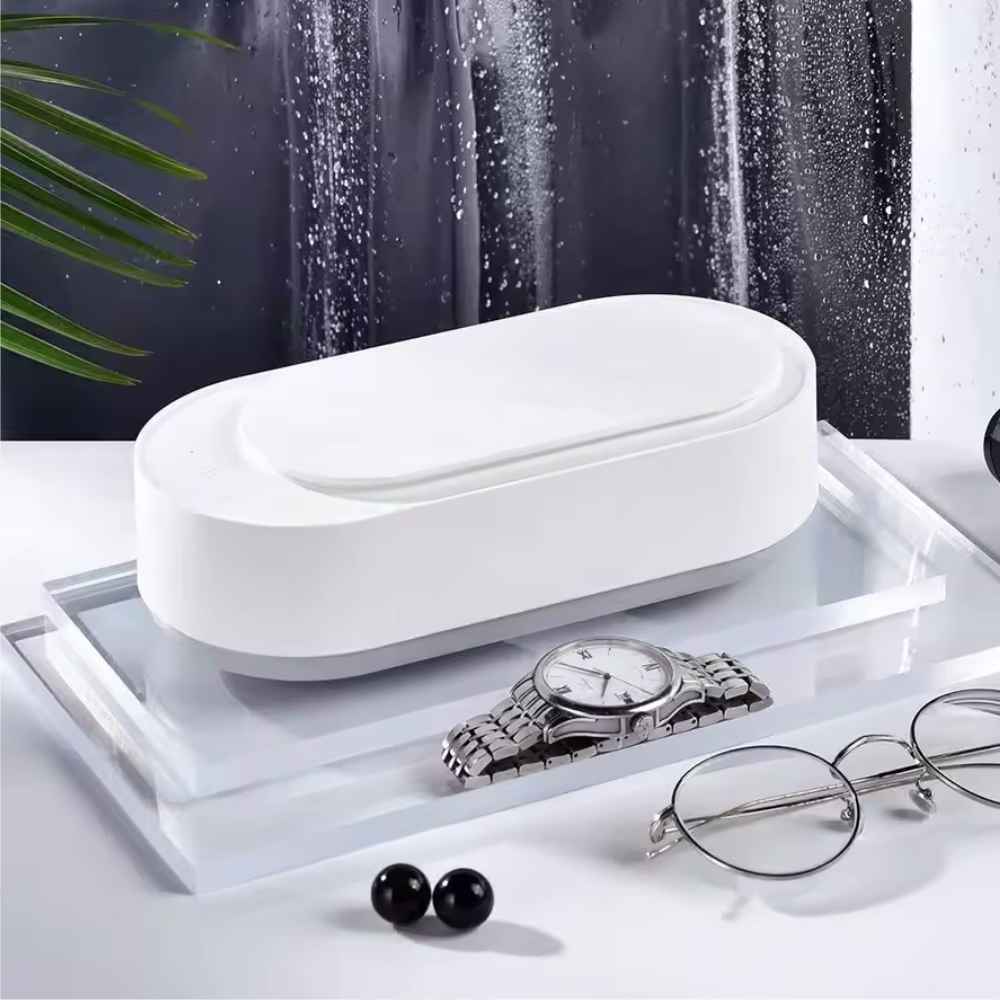
The Portable Ultrasonic Cleaner stainless steel tank (158mm x 68.5mm x 38.5mm inside) is sized for most eyeglass frames laid flat, a watch bracelet removed from the case, or three to four rings at once. At 345g total weight including the compact ABS housing, it fits in a toiletry bag without reorganizing anything else, like a perfect compact ultrasonic cleaner for glasses.
At 15W running from a 12V adapter, power draw is low enough to run off a travel adapter in any country without a converter. The 3-minute auto-shutoff means you set it and handle something else.
One honest limitation: this unit has no heater. For glasses and jewelry with standard stone settings, room-temperature water works. For anything adhesive-bonded or glued, skip the ultrasonic bath entirely, the listing says as much and it is worth taking seriously.
3 advantages of the Portable Ultrasonic Cleaner for Glasses & Jewelry:
- 45,000Hz frequency: higher than standard 40kHz consumer units, producing finer cavitation bubbles suited to optical coatings and delicate prong settings rather than heavy degreasing.
- 3-minute fixed cycle with auto-shutoff: no guesswork, no leaving it running and forgetting. The timer does the work.
- SUS304 stainless steel tank : corrosion-resistant, compatible with diluted dish soap or dedicated jewelry solution without pitting over time.
Portable Ultrasonic Cleaner Built For the Daily Glasses Wearer Who Travels:
A contact lens wearer who switches to frames on weekends, staying in hotels three nights a week, does not want to pack a bulky cleaning station. This unit drops into the same pocket as a charger, runs off the room's outlet, and has frames looking optician-fresh before a morning meeting. No appointment, no $15 cleaning fee, no waiting.
If your glasses or rings are cleaned with whatever cloth is nearby, the results show it. A 3-minute cavitation cycle on a 45kHz tank changes the baseline. Add it to your everyday carry and see what your lenses actually look like clean thank to a good ultrasonic cleaner.
Share


FAQ - Ultrasonic cleaner
What is an ultrasonic cleaner and how does cavitation work?
An ultrasonic cleaner uses a transducer to project high-frequency sound waves (typically 40 kHz) through a liquid bath. Those waves create and collapse millions of microscopic bubbles per second a process called acoustic cavitation. Each collapse generates a localized pressure jet that physically dislodges contaminants from every surface it reaches, including recesses, hinge barrels, prong settings, and blind holes that no brush can access.
The result is a contact-free clean that outperforms manual methods in both speed and thoroughness. A professional jeweler in Denver running an ultrasonic tank for 4 minutes on a gold ring pulls out more skin oil and lotion residue than 10 minutes of brushing could reach not because the machine is more powerful, but because cavitation reaches geometry that bristles physically cannot.
How long does an ultrasonic cleaning cycle take?
Cycle time depends on material and soil type, not machine power alone. Defaulting to the longest cycle is not safer over-cycling at elevated temperature can damage coatings and loosen adhesive-held components on items that were otherwise compatible.
Glasses (light soiling) : 2–4 min 50°C
Gold / platinum jewelry : 3–6 min 60°C
Retainer / aligner (mineral deposits) : 5–8 min 45°C
Watch bracelet (no movement) 5–8 min 50°C
Dental instruments : 10–15 min 60°C
Gun parts (carbon fouling) : 15–20 min 60°C
Carburetor bodies : 15–20 min 65°C
How do I contact Sonirity support?
📧 contact.sonirity@gmail.com
For product selection guidance, order questions, returns, and technical troubleshooting. For fastest response on product compatibility questions, include the item you're trying to clean and the model you're considering, Owen reviews all technical inquiries personally.