


Sonirity
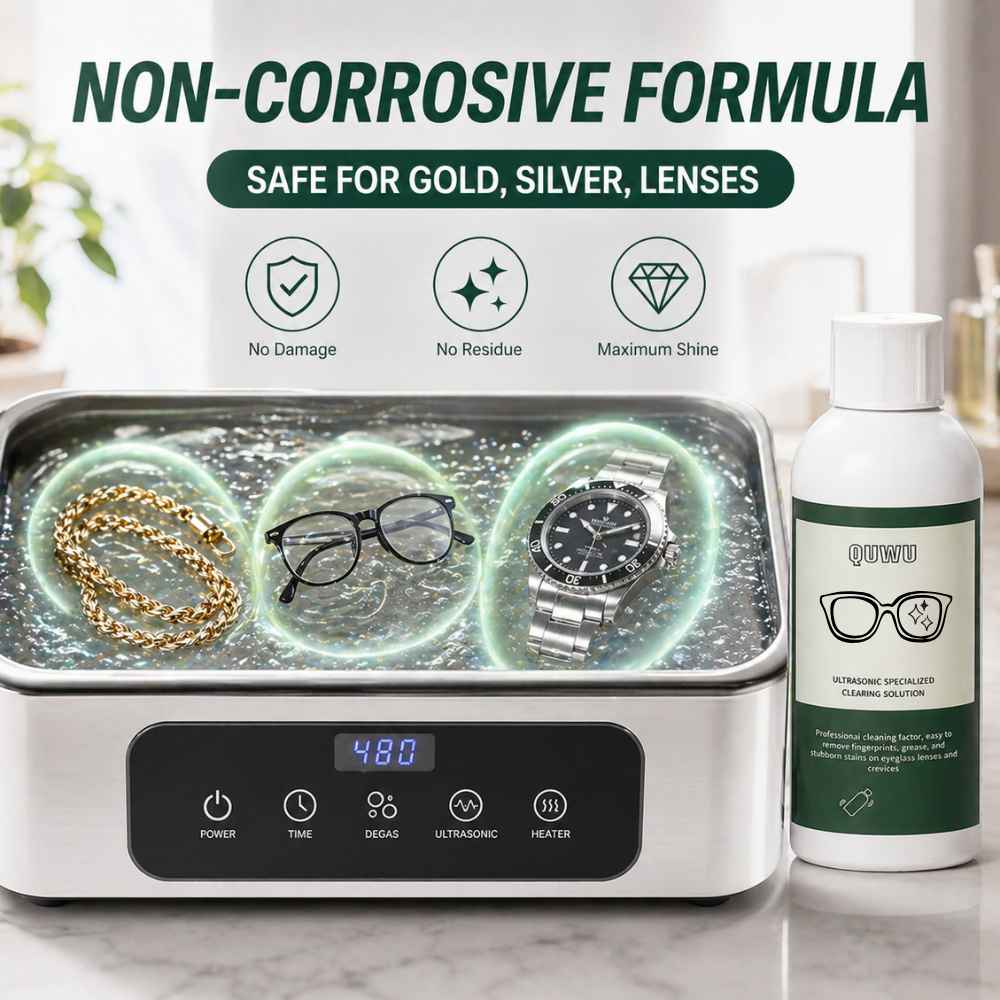
Ultrasonic Glasses Cleaner Solution | Deep Cleaning
Ultrasonic Glasses Cleaner Solution | Deep Cleaning
☑️ Cleans What Cloths Can't Reach
☑️ Ultrasonic Cavitation Technology
☑️ Auto Shut-Off, No Over-Cleaning
☑️ Results in Minutes, No Scrubbing
Couldn't load pickup availability
Every optician will tell you the same thing off the record: microfiber cloths redistribute oil. They do not remove it. You wipe, the lens looks clear under indoor light, then you step outside and every fingerprint from the last three days reappears in the glare. If you wear progressives with an anti-reflective coating, you already know exactly what that looks like.
Why water alone fails your glasses ?
Most people who own an ultrasonic cleaner fill the tank with tap water and call it a setup. For metal parts, that works acceptably. For AR-coated lenses, it does not.
Skin oil is lipid-based. Water is polar. Without a surfactant molecule designed to bridge that gap, your 40kHz cavitation field agitates the bath without actually breaking the oil-to-coating bond. The lens comes out warm and slightly wet, which feels clean. It is not.
The poloxamine formula in this solution acts as a molecular bridge: one end attaches to the lipid layer, the other stays water-soluble, so when the cavitation bubble collapses against the lens surface, the oil lifts completely rather than shifting position.
Result: optically clear surface, not just visually acceptable in dim light.
Try the Ultrasonic Glasses Cleaner Solution now:
- pH-neutral, non-abrasive formula Why it matters for glasses: AR coatings are applied in layers thinner than a human hair. A single acidic or alkaline cleaning cycle degrades the outermost layer permanently. Neutral pH means you can clean daily without accelerating coating wear.
- Residue-free rinse behavior Why it matters: Standard dish soap leaves a surfactant film that creates its own haze under polarized light. This formula rinses completely clean in one water pass, no secondary bath needed.
- Safe on plastic frames, titanium, acetate, and mineral crystal Why it matters: A single cycle handles the full pair, frame included, without warping acetate or dulling matte titanium finishes. No disassembly required.
- 50ml travel size available Why it matters: Fits in a glasses case side pocket. One bottle lasts roughly 6 to 8 weeks of twice-weekly cleaning for a single pair.
Built for the Progressive Lens Wearer Done Rewearing Smeared Glasses:
You spent $400 on lenses with blue-light filtering and anti-reflective coating. You clean them six times a day with the cloth that came in the case. By month three, there is a permanent haze in the center of the right lens that no amount of wiping touches. That is not a scratch. That is compacted oil residue bonded into the coating microstructure.
A 5-minute cycle in an ultrasonic bath with 4 to 5 drops of this solution pulls that layer out completely. The first time it happens, it is genuinely surprising how different the lens looks. Not "a bit better." Different.
A note on what Deep cleaning Solution will not do:
It will not fix a scratched coating. If the AR layer is physically compromised, no cleaning solution restores it. What it does is remove everything that is not supposed to be there, so you can finally tell the difference between a coating that is failing and one that was just dirty.
That distinction alone has saved more than a few people an unnecessary $400 lens replacement.
Your ultrasonic cleaner already has the frequency. This solution gives it the chemistry to match. Add it to your cleaning routine and run one cycle before you decide those lenses actually need replacing. And to discover more ultrasonic cleaner solution, click on our collection...
Share


FAQ - Ultrasonic cleaner
What is an ultrasonic cleaner and how does cavitation work?
An ultrasonic cleaner uses a transducer to project high-frequency sound waves (typically 40 kHz) through a liquid bath. Those waves create and collapse millions of microscopic bubbles per second a process called acoustic cavitation. Each collapse generates a localized pressure jet that physically dislodges contaminants from every surface it reaches, including recesses, hinge barrels, prong settings, and blind holes that no brush can access.
The result is a contact-free clean that outperforms manual methods in both speed and thoroughness. A professional jeweler in Denver running an ultrasonic tank for 4 minutes on a gold ring pulls out more skin oil and lotion residue than 10 minutes of brushing could reach not because the machine is more powerful, but because cavitation reaches geometry that bristles physically cannot.
How long does an ultrasonic cleaning cycle take?
Cycle time depends on material and soil type, not machine power alone. Defaulting to the longest cycle is not safer over-cycling at elevated temperature can damage coatings and loosen adhesive-held components on items that were otherwise compatible.
Glasses (light soiling) : 2–4 min 50°C
Gold / platinum jewelry : 3–6 min 60°C
Retainer / aligner (mineral deposits) : 5–8 min 45°C
Watch bracelet (no movement) 5–8 min 50°C
Dental instruments : 10–15 min 60°C
Gun parts (carbon fouling) : 15–20 min 60°C
Carburetor bodies : 15–20 min 65°C
How do I contact Sonirity support?
📧 contact.sonirity@gmail.com
For product selection guidance, order questions, returns, and technical troubleshooting. For fastest response on product compatibility questions, include the item you're trying to clean and the model you're considering, Owen reviews all technical inquiries personally.