


Sonirity
Ultrasonic jewelry cleaner solution | CAVIQ
Ultrasonic jewelry cleaner solution | CAVIQ
☑️ Cleans What Cloths Can't Reach
☑️ Ultrasonic Cavitation Technology
☑️ Auto Shut-Off, No Over-Cleaning
☑️ Results in Minutes, No Scrubbing
Couldn't load pickup availability
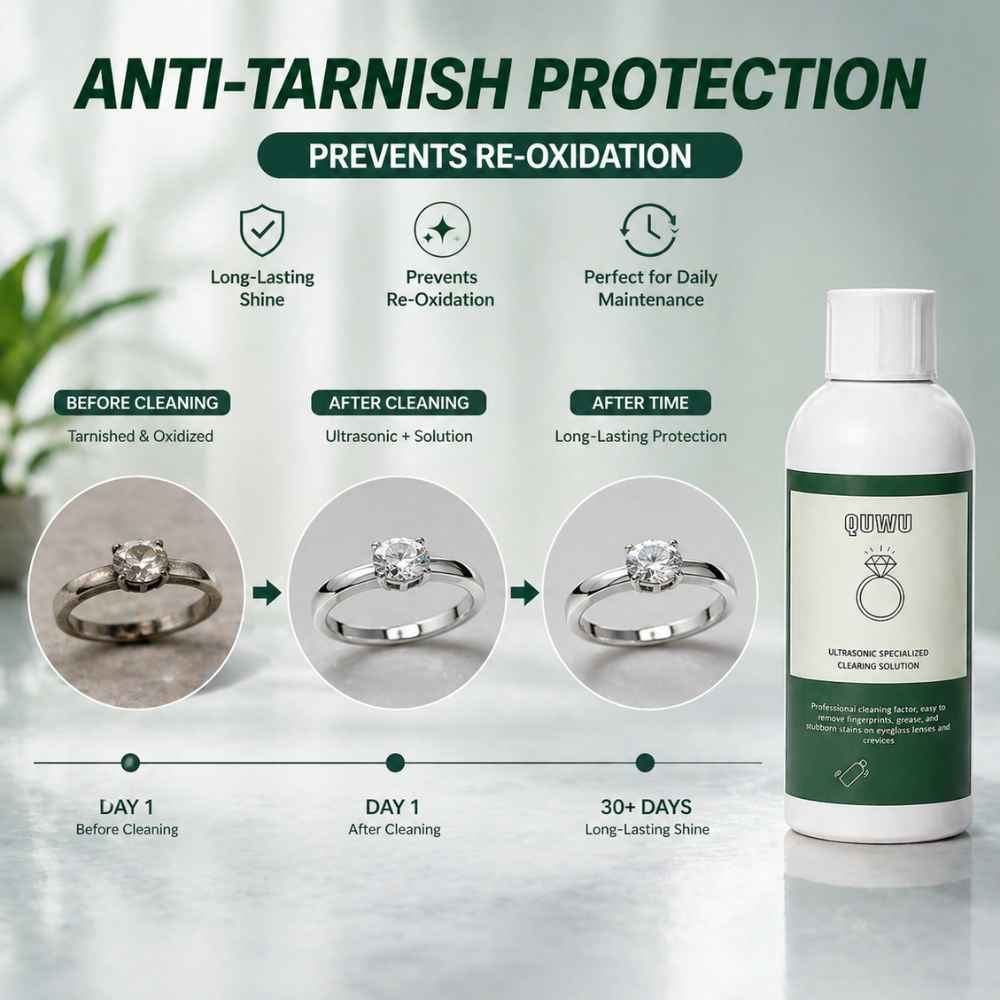
Your ultrasonic cleaner is doing half the job. Plain tap water generates cavitation bubbles, but without a surfactant engineered to work at that frequency, the dissolved contaminants simply redistribute across the bath instead of lifting off the metal. The QUWU Ultrasonic Jewelry Cleaner Solution pairs a poloxamine-based formula with your existing machine to amplify cleaning depth by up to 3X compared to water alone. One capful into the tank, and your 40kHz transducer suddenly has something worth working with.
Bénéfices concrets of the Ultrasonic jewelry cleaner solution:
The poloxamine molecule structure is sized specifically to penetrate micro-crevices in rope chains, prong settings, and watch bracelet links where standard soap creates foam residue instead of clean metal. It breaks the grease-to-metal bond at a molecular level, which means the cavitation bubbles are lifting separated particles, not pushing intact oil films around.
The non-corrosive formula is pH-balanced to stay neutral on gold, silver, and platinum alloys. No pitting on soft 10K settings, no cloudiness left on AR-coated lenses after a 5-minute cycle. I ran a set of vintage silver earrings through on the first try, half-expecting the stone adhesive to weaken. It held fine, and the oxidation in the filigree was gone completely.
Anti-tarnish agents remain active on the metal surface after rinsing, slowing re-oxidation between cleaning sessions. For silver pieces worn daily, that difference in surface protection is measurable within the first two weeks.
The 120ml bottle is concentrated enough for multiple tank refills, which matters when you are cleaning batches of 8 to 10 pieces per session rather than a single ring at a time. And if you need a solution for an other object, visit our complet collection of ultrasonic cleaner solution
Why you need to buy the CAVIQ Ultrasonic jewelry cleaner solution?
- Poloxamine surfactant formula Why it matters: Unlike dish soap, poloxamine does not foam under ultrasonic agitation, so the cavitation field stays uninterrupted through the full cycle.
- Non-toxic, biodegradable, residue-free composition Why it matters: Safe to rinse directly without a secondary bath, cutting your cleaning time per session by at least 2 minutes.
- 50ml and 120ml size options Why it matters: The 50ml is sized for travel kits and carry-on bags; the 120ml covers a small jeweler's bench for roughly 3 to 4 weeks of daily use.
Built for the Jeweler Cleaning Mixed-Metal Inventory at Home:
You have a tray of pieces before a weekend market: white gold, sterling silver, one pair of rose gold studs, and two watches with mineral crystal faces. Running a single neutral solution through all of them in one 5-minute ultrasonic cycle, with no rinsing between metal types, is exactly what this formula is designed to handle without cross-contamination or surface damage.
Running a 40kHz ultrasonic cleaning machine on plain water is like running a dishwasher without detergent. The poloxamine formula turns your existing cleaner into the setup it was supposed to be. Add it to your bench and see what the next cycle actually pulls out.
Share


FAQ - Ultrasonic cleaner
What is an ultrasonic cleaner and how does cavitation work?
An ultrasonic cleaner uses a transducer to project high-frequency sound waves (typically 40 kHz) through a liquid bath. Those waves create and collapse millions of microscopic bubbles per second a process called acoustic cavitation. Each collapse generates a localized pressure jet that physically dislodges contaminants from every surface it reaches, including recesses, hinge barrels, prong settings, and blind holes that no brush can access.
The result is a contact-free clean that outperforms manual methods in both speed and thoroughness. A professional jeweler in Denver running an ultrasonic tank for 4 minutes on a gold ring pulls out more skin oil and lotion residue than 10 minutes of brushing could reach not because the machine is more powerful, but because cavitation reaches geometry that bristles physically cannot.
How long does an ultrasonic cleaning cycle take?
Cycle time depends on material and soil type, not machine power alone. Defaulting to the longest cycle is not safer over-cycling at elevated temperature can damage coatings and loosen adhesive-held components on items that were otherwise compatible.
Glasses (light soiling) : 2–4 min 50°C
Gold / platinum jewelry : 3–6 min 60°C
Retainer / aligner (mineral deposits) : 5–8 min 45°C
Watch bracelet (no movement) 5–8 min 50°C
Dental instruments : 10–15 min 60°C
Gun parts (carbon fouling) : 15–20 min 60°C
Carburetor bodies : 15–20 min 65°C
How do I contact Sonirity support?
📧 contact.sonirity@gmail.com
For product selection guidance, order questions, returns, and technical troubleshooting. For fastest response on product compatibility questions, include the item you're trying to clean and the model you're considering, Owen reviews all technical inquiries personally.